
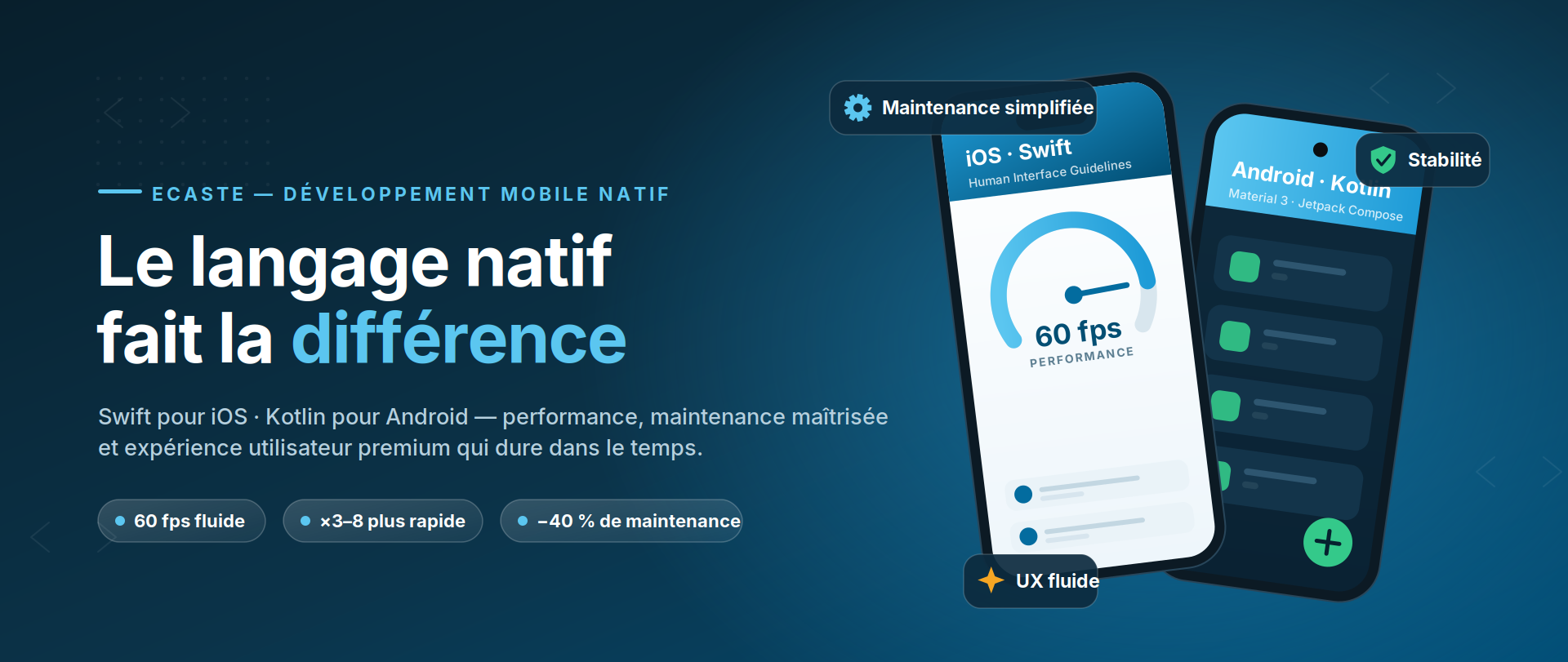
After 16 years of mobile development and over 50 applications delivered at ECASTE, one observation stands out: applications developed in native language (Swift for iOS, Kotlin for Android) are consistently more performant, more stable, and less costly to maintain in the long run. Here's why.
A user experience that makes the difference
Mobile users are demanding. According to Apple, an application that takes more than 3 seconds to load loses 53% of its users. Native language allows direct use of the GPU and system APIs, resulting in smooth animations at 60 frames per second, instant transitions, and immediate touch responsiveness.
With Swift and SwiftUI, an iOS developer natively accesses Apple's Human Interface Guidelines: system gestures, haptic feedback, Dynamic Island, widgets. The application integrates naturally into the user's ecosystem, where cross-platform frameworks only approximate these behaviors.
On the Android side, Kotlin and Jetpack Compose offer the same advantage: native compliance with Material Design, perfect integration with Google services, and direct access to all hardware APIs (sensors, camera, NFC, Bluetooth LE).
Maintenance: the real hidden cost of a mobile application
The initial development of an application represents only 30 to 40% of its total cost over 5 years. The rest is maintenance. And that's where the choice of native makes all the difference.
Every year, Apple and Google release new versions of their operating systems. With a native application in Swift or Kotlin, compatibility is immediate: new APIs are documented and accessible from day one. No need to wait for a third-party framework to implement them.
With a cross-platform framework (React Native, Flutter), each major iOS or Android update can require weeks of waiting for the framework to publish a fix. In the meantime, your application may have visual bugs, crashes, or even be removed from the App Store for non-compliance.
Fewer dependencies, fewer risks
A native application depends solely on the official Apple or Google SDK, maintained by teams of thousands of engineers. A cross-platform application adds an additional layer of dependencies: the framework itself, its plugins, its native bridges, and its entire open-source ecosystem.
Each additional dependency is a point of fragility: a library abandoned by its maintainer, an incompatibility between versions, an unpatched security vulnerability. At ECASTE, we have seen cross-platform projects become impossible to update after only 2 years, because the framework had introduced breaking changes incompatible with the plugins used.
Debugging: native vs cross-platform
When a bug occurs in a native application, the developer has Xcode for iOS or Android Studio, the official platform tools. Error messages are clear, profilers are precise, and the stack trace points directly to the offending line.
In a cross-platform environment, a bug can be in your JavaScript/Dart code, in the native bridge, in a third-party plugin, or in the framework itself. Diagnostic time is multiplied by 2 to 3, which directly increases maintenance costs.
Measured performance: Swift and Kotlin lead
Benchmarks speak for themselves. On common operations (JSON parsing, list rendering, complex animations, local database access), Swift is on average 3 to 8 times faster than JavaScript (React Native) and Kotlin 2 to 5 times faster than Dart (Flutter). This difference is felt directly in the user experience, especially on entry-level devices.
Memory footprint is also reduced: a native application typically consumes 30 to 50% less RAM than an equivalent cross-platform application, resulting in better battery life and fewer memory-related crashes.
Immediate access to the latest innovations
Apple Intelligence, ARKit, Vision Pro, Core ML, HealthKit, Live Activities, Dynamic Island, App Intents... All these technologies are accessible immediately and natively in Swift. On the Android side: Gemini Nano, CameraX, Wear OS, Auto... accessible directly in Kotlin.
Cross-platform frameworks only integrate these features 6 to 18 months later, often partially or via unreliable community plugins. By choosing native, your application benefits from innovations as soon as they are released — an important competitive advantage.
When does ECASTE recommend native?
With our 16 years of experience and 2 attendances at Apple's WWDC, we systematically recommend native development for:
- Applications that need to offer a premium user experience
- Projects with a lifespan of more than 2 years
- Applications requiring advanced hardware features (AR, ML, Bluetooth, NFC)
- Applications subject to performance constraints (real-time, video processing, games)
- Projects requiring regular maintenance and long-term scalability
Cross-platform may be suitable for a quick MVP or a simple application with a limited budget. But for an ambitious product built to last, native remains the best investment.
Are you hesitating between native and cross-platform for your project? Contact ECASTE for personalized advice based on your constraints and objectives.