
For more than 16 years, ECASTE has been designing custom web and mobile applications for companies of all sizes, from small businesses in Antibes to research laboratories. We built this experience project after project, technology after technology. Artificial intelligence is the latest of these technologies, and probably the most transformative. We do not approach it as a trend, but as a new tool serving a craft we know well: building software that meets real needs.
AI at two levels: in the making and in the product
When people talk about integrating AI, they often mix up two very different things. At ECASTE, we keep them clearly separate, because they do not bring the same value.
The first is AI as a development accelerator. Analyzing a specification, generating code, writing tests, reviewing, documenting, migrating from one framework version to another: at every stage of building a product, AI tools allow us to move faster and devote our time to what really matters, understanding your business and the quality of the architecture. We use these tools every day, in a controlled way, without ever delegating responsibility for the result to them.
The second is AI as a feature of the delivered product. An assistant that answers your teams' questions from your documents, a chatbot that informs your customers on your website, automatic classification of incoming requests, data extraction from scans or invoices. Here, AI is no longer in the workshop, it is in the application your users handle every day.
A concrete example: the ECASTE document assistant
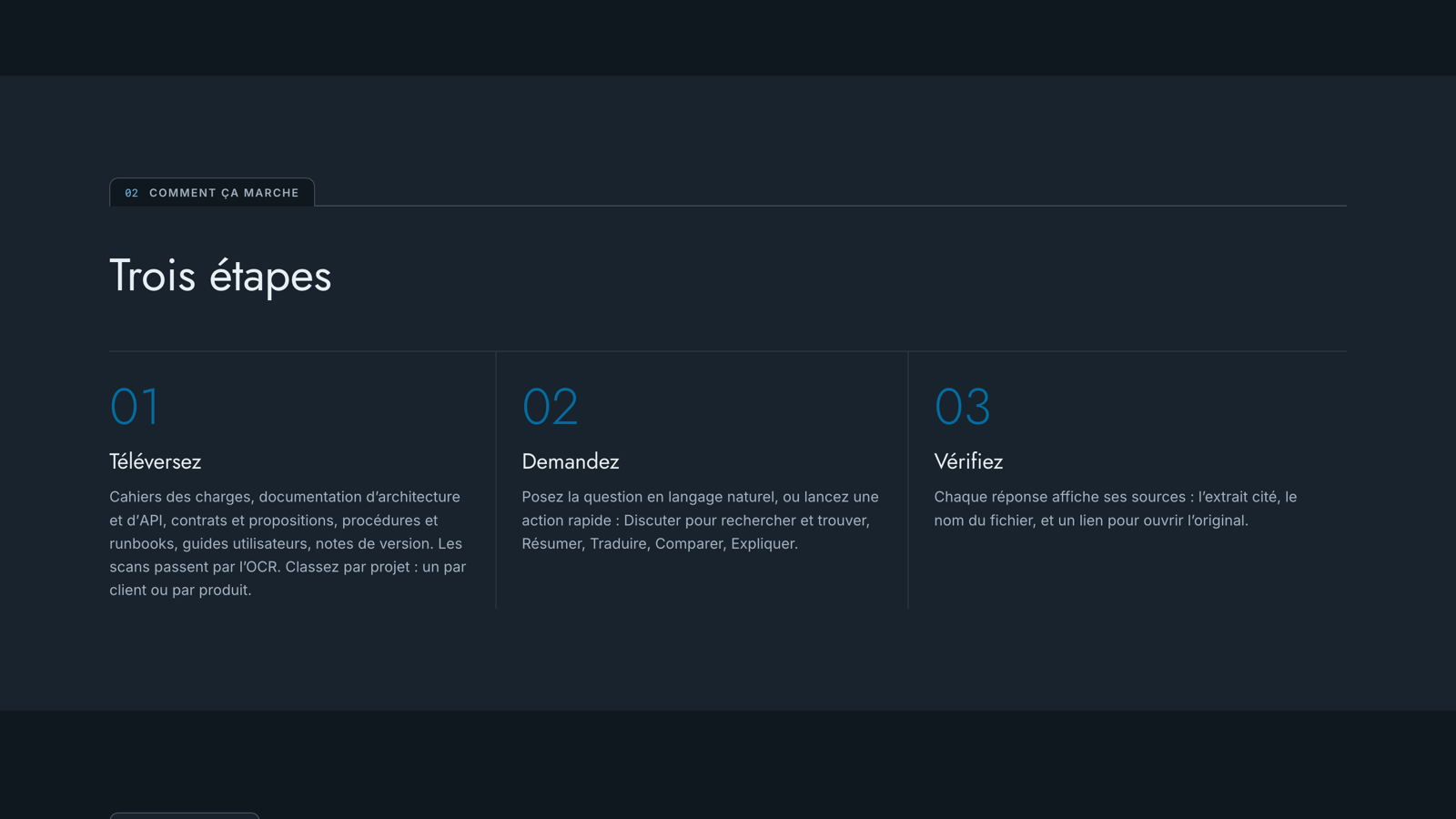
To master these technologies, we first applied them to ourselves. We developed a document assistant based on a RAG (retrieval-augmented generation) architecture: your specifications, contracts, procedures and technical documentation are indexed in a vector database, and every answer cites the exact excerpt and the source file.
The key point of this project is data confidentiality. Mainstream AI tools send your documents to third parties, often outside Europe. Our solution works differently:
- The documents, their metadata and the vector index stay stored locally, in the client's instance.
- The language model is chosen per request: an LLM hosted by a Swiss provider, or OpenAI, or Anthropic depending on the sensitivity level and the need.
- Calls to the models leave from the server; no API key is exposed in the browser.
- A chatbot widget embeds in a few lines on your website, fed by documentation generated automatically from the site's content and then enriched manually by your teams.
This solution, built with FastAPI, Vue.js and the Qdrant vector database, illustrates what we can do today: harness the power of large language models without giving up control of your data. You can discover it in our portfolio.
AI at every stage of the production cycle
What this assistant taught us goes far beyond the use case. We are now able to use AI as a tool at every stage of the product manufacturing process:
- Scoping: analysis of your existing documents, reformulation of needs, detection of grey areas in a specification.
- Design: rapid exploration of several architectures, mock-ups, disposable prototypes to validate an idea before investing.
- Development: assisted code generation, systematic review, automated tests, technical migrations.
- Production and maintenance: log analysis, anomaly detection, living project documentation.
- Product: integration of agents, assistants or AI functions directly into your web or mobile application, in native iOS and Android as well as on the web.
At every stage, the rule is the same: AI proposes, the ECASTE team decides and takes responsibility. This is what guarantees our clients maintainable, understandable and durable software, not a black box.
A team in continuous training
AI models, tools and best practices evolve every month. To stay at the required level, the entire ECASTE team trains continuously, and we have chosen the most demanding way to do it: internal development. Rather than just reading the documentation, we build our own tools, put them into production and make them evolve. The document assistant is the first example; others will follow.
This approach has a simple goal: to provide the best service to our clients. When we recommend a RAG architecture, a model hosted in Europe or, on the contrary, a simple automation without an LLM, it is because we have tested it, measured it and sometimes ruled it out on our own projects.
"AI does not replace experience, it multiplies it. Sixteen years of custom development allow us to know where it brings value, where it wastes time, and where it puts your data at risk. This is the expertise we put at the service of our clients." — Emmanuel Castellani, founder of ECASTE
Integrating AI into your company, tailor-made
Would you like to integrate artificial intelligence into your company, but do not know where to start, or are you worried about the confidentiality of your data? This is exactly the kind of project for which ECASTE is your partner. We have no product to sell you at all costs: we design custom tools, adapted to your business, your constraints and your data.
- An audit of your processes to identify genuinely useful use cases
- An architecture that respects the confidentiality of your data, on premises or with a European host
- Development integrated into your existing or future web and mobile applications
- A single point of contact, in person, in Sophia-Antipolis, Nice, Antibes, Cannes or Monaco
Conclusion
With its experience and expertise in web and mobile development, ECASTE is the partner for your custom software, which can now integrate artificial intelligence: as an accelerator in the way we work, and as a feature in the products we deliver to you. The document assistant is the concrete proof: the power of LLMs, the confidentiality of your data.
Do you have an AI project, or just an intuition? Contact us: we will help you turn that intuition into a custom tool that is useful and under control.